They Are Together Now

It’s been 4 years. And it’s also been 3 years.

I’ve lost them both.

The apples of my eye, the lights of my life, whom my life revolved around and without whom I couldn’t have ever imagined my life. I’ve lost them both.

It’s been 3 years since I’ve written something to ease my grief. I cannot begin to describe how cathartic it has been for me to write my grief away. But Kaafa passing just months after Maama left us was just incomprehensible to me. I hadn’t predicted this. And so I stopped writing and embraced it. Head-on. No more catharsis.

I remember it being 24 hours since I last slept. I had done my assigned rounds and procedures and was sitting in a bustling tea room having an egg cutlet and a glass of milk tea with a few of my closest friends. We were just counting down until the Professors’ arrived to get their rounds done so that we could all go home and get some well-deserved sleep. It was well past 12 at noon. I remember feeling numb from the sleep deprivation. Most days, although I was ‘body-tired’ I still had some soul left in me to endure a few more hours. I suppose that was because I loved the work. I remember being completely absorbed in conversation when my phone rang.

‘Mamma’.

By then, it had been a few weeks since Kaafa was taken to the hospital and admitted for a Gastric Outlet Obstruction back in Male’. I had been keeping in touch with family back at home so that I could time my leave from work appropriately. I wanted to be with Kaafa when he needed me most. I didn’t want to run out of my leave days and end up forced to return prematurely. By then I had always known that at 90 years his time was quickly running out. Until then, I had always been told that Kaafa was still doing okay and that I need not come in haste. But this time, the call was different.

‘I think it’s time you come home’.

I immediately applied for leave from work effective immediately so that I could be on the next flight home. Next flight home turned out to be the next morning. ‘That gives me a safe window to get home and see Kaafa’, I had thought.

The next night I couldn’t get a restful sleep. I tossed and turned and just skimmed on sleep. I remember being woken up to the sound of my husband’s phone ringing just a little while before my alarm was set for to wake me up to leave to the airport. The call was from my mom. My heart sank.

‘What are they saying? Tell me what they are saying. He’s gone, isn’t he? I’m too late, aren’t I?’

I remember how my husband’s lips quivered as he handed me the phone.

‘Kokko. Kaafa is gone’.

My world imploded in on itself in a second. Just like that.

‘We need you to make a decision. I’m sorry. Today is Friday. And we need you to tell us if we should keep him until you come or if we should bury him for Friday prayers.’

‘Bury him’, I did not hesitate for a second. ‘That’s what Maama and Kaafa would have wanted. Bury him for Friday prayers’.

I remember screaming into a pillow. I was frustrated at the universe. I felt let down. I felt alone. It was just 5 hours of travelling between Kaafa and I, and yet fate had decided against me. I had saved my all my leave days from work for the last 10 months to be with him when he needed me most. I had planned it perfectly so that I could hug him one more time and say that I loved him with all my might. I remember screaming into the morning until I had no more anger in me. I had 5 hours of travelling in front of me to endure knowing that I had missed him for eternity. I would never have closure.

I remember sitting .. just sitting in the cab, the airport, the plane from one airport to another, the raindrops on the window of the car, the shuffling of food trays, muffled voices, the sound the wheels of the suitcases made on the cement and nausea. I remember holding back tears and my husband rubbing my back and just being ever-present like my rock that he is.

And I remember finally coming home to my mom’s face.

Tired. She was so tired.

But I also remember that vague sense of relief I felt. It wasn’t because neither Maama nor Kaafa had ceased suffering anymore. It was because of, I realised, that one true fact my husband had been repeating to me ever since we left the dusty roads of Chittagong.

‘They are together now’.

My thoughts today

Aminath Latheefa

It has been over 2 years since our Mum left us. Mother whom we would like describe as a woman of substance who regularly and passionately follows news and the political changes that have been happening throughout her life till her very end. She is one of a kind who not only follows the news but voices her opinion relating on the history of the country over the years. Today at this juncture in the midst of political drama unfolding in our country we in our house wonder what would be her thoughts and her views regarding the current twists and turns of events happening in our country.

We recollected the times together when we were overjoyed and jubilant in 2008 as ordinary citizens when we experienced the incredible transformation that came with change of government. We used to say it is like from a kingdom to a less strict and less scary to a freer life. When the walls of the Sultan Park which housed the 16 Century Royal Palace was demolished and the people of all nationality irrespective of caste and creed can walk freely through it seems like a blue print or a representations of the changes that is in store for the country. It seems so apt to illustrate the transformation from kingdom to a freer life when the chained walls surrounding the gardens of Royal Palace were no longer there as we walk through the park for short cuts to go the market.

Few instances that marked the change embedded in our mind says it all. Our friend once narrated that people like princes are sitting with ordinary people in the ferry going to the airport. Our parents friend F. Magoodhoo Yoosubbe’s excitement during his visits to Male, face lighting up with a wide smile as he has cash on hand through old age pension illustrates the change. The gratefulness of patient in next bed in the hospital for getting medical treatment due medical insurance are pictures that will never fade. Tax or the important big shift made to reduce the rising gap between the rich and poor marked the changes and brought sense of calm and pride for the leader who had made it all possible. The private channels and news article and freedom of speech excited us all and the talent within us all seems to have reached a new level. The glow on elderly person’s face and the smile on the children during his visits to the remote island of the country speak volumes of the changes accepted by all.

As like my parents so many of us welcomed this change which seems so very right and many of us has no doubt about its continuance. It is well known the sacrifices that have made almost by a single person over years of struggle was long and arduous and often make us wonder how and who else can keep on sacrificing himself selflessly over the years to reach it. As days go by in the political spectrum stars rise and fall but that one star that made it all happen stands tall and straight not taking a u turn, without meandering never giving up an inch in his determination for the change which he began.

The sheer grit to change needs motivation and drive to keep on going in spite of obstacles to reach it. Often the question that pops up on our thoughts at home and during coffee table political discussion are can just any one be so sincere and selfless? Can just anyone continue as a capable and a proud leader without enduring the immense sacrifices to achieve it? Can a new leader move forward with that same resolve, vigor, effort, energy and determination without going through that long road in the past to achieve what has been achieved? To put more bluntly can anyone else deserve it more than that leader who made it possible? And most importantly is it ethical or fair not fight for the still young, energetic and deserving game changer who made history by tearing apart a thirty year old monarchy type of rule which literally took our breath away?

Wonder how mother would answer these questions. She is surely and sorely missed at home.

All The World Is A Stage

The following piece is from the pen of my mother, who saw Maama’s every up and every down very closely from the start until the very end, and continues to do so for Kaafa. I am witness to how constantly yet firmly Mamma held Maama’s hand throughout this journey and continues to hold Kaafa’s hand the same. 

By Aminath Latheefa

Dad grips my hand tightly as I sit next to his bed on a white plastic chair. My right hand rest on railing of the steel bed to hold his left hand. Today is Eid, 8 months have gone since my mum had passed way.”Where is Mamma?” My father asks me, turning his head towards me, confused with dementia. I reply to him “mamma has passed away”. He asks “when?” I reply ,“8 months back” truthfully. He asked and I cleared it for him. “Where is she now?”, “She is laid to rest”. “Where?”, “She is laid to rest in Aasahara”. He stares straight ahead his gaze resting on the ceiling. Color has faded from his eyes as cataract filled his once bright and lively eyes. He clutched one hand to the railing of the bed while the other hand grips my hand tightly, and calls my name again followed by the same set of questions. “Yes Bappa”. I try to practice patience in answering him until he lay spent, tired as he sighs and finally says “Mamma has also gone isn’t it?” He takes a deep breath again and continues gazing silently towards the ceiling. His caretaker, who sits in a bamboo chair in the room glances at me and smiles.

While I sit holding his hand my mind went back in time, recollecting the happier times of his life. I always remember my father as an active, easy going person who doesn’t worry so much. He wakes up at dawn for the early morning prayers and he goes out wearing his jogging shoes to take a walk around Male’ before he heads home. In the recent past he used to waters my Mum’s few plants in the balcony before taking breakfast prepared by mother to whom he was married for more than 60 years. I have lived all my life with them and have seen them laugh, joke and voice their differences together. As I remiscint about them I feel a sense of pride for their strength in their life’ journey. They have travelled together, mostly through rough seas yet they have stood firm, weathered the passing storms with dignity and determination. Being hard working, truthful and sincere my mother have refused to get swayed out of focus in life’s meandering paths. As I look back, I feel that they are incomplete, far apart and becomes deficient and partial when one is no more. It is like one half can never be complete.

When Mum passed away, Dad’s life crumbled and collapsed. He broke apart, lost balance and literally was not able to go and see my Mums face for the last time. Since then Dad’s enthusiasm and liveliness for life suddenly waned with no ability to eat, walk and talk like his usual self. As I sit in the white plastic chair, gazing through wide glass door, partially covered by the floor length blue curtains, overlooking the road, I see shades of green in the foliage of the neighbor’s Moonima tree over the balcony. The leaves rustles lightly, swaying in rhythm with the breeze while bees hover around the flowers, busy in their own routine of getting the nectar from flowers. I hear some birds in the tree which has grown and spread its branches across the road. In addition to the shade to the road, the tree has given a picturesque and a pleasing view to my parents’ bedroom, such a blessing at their old age. The tree provides opportunity for my mother to perceive and observe natural changes occurring over time. She notes the caterpillars from the butterflies’ eggs eating away the leaves of the tree. She spots birds building nest in the tree. As my mind wonders on the past, the sound of the blasting of horns from the vehicles on the road brought me to the present. The traffic is busy as usual which gives the impression that life is still the same with ordinary and typical day today activities going on.

At times I made efforts to make some light conversation with my father, to bring some life into him by indulging in the pleasurable recollections of the past. I feel he is often nostalgic with the sentimental longing for the past. A wistful affection for his good old days with Mamma lingers on his small wrinkled face as we reminisce my mums character and routines. She used to stand in the balcony, almost every evening observing the surroundings and pointing out interesting anecdotes. She takes notice of the passerby’s, calls to neighbors and often makes small talk with them. She takes keen interest in the neighbor’s cat across the road and used to call us to show the cat’s behavior. She doesn’t like when the tree blocks her view of the right end of the road and even requested the neighbour to cut a little bit of it, which the neighbour gracefully obliged so that she has the full view of the road.

We always think that my mother is larger than life in character. Her love for growing plants perhaps have made me appreciate and care for her plants. Her few plants are being maintained in her small balcony, while some more have been added. Her love to display our photos in the sitting room wall are hallmarks of her love for her family and the pride she takes in us. We use to fondly refer to her photo collection she has placed on the wall as the wall of fame.

Even in her last days at home she was interested in her atmospheres and the ambience around. An ardent supporter of President Nasheed, politics is one her favorite subjects and I remember the long distance Friday phone calls, I have made to her often centers on news of political situation. She catches up on news through a small radio which she keeps next to her when she is not able to watch the news from TV. She used to update me on the political events and we feel a special bond or comradeship over our common political views.

My Mother is resilient, dedicated and composed in nature. We used to admire her calm composure and serene gait and we have agreed that we have never seen her in haste in contrast to us who are clumsy and is always rushing around, charging all over the place. Stories of her childhood, experiences of her youth and lessons from her past fascinates us and have guided and molded us as who we are, today. Her merriment and her way speaking metaphorically in expressing herself is special and signifies who she is. Stories of love, jealousy and enmity have been told and retold and are important life changing events which also denotes her tireless and persistent character.

Indulging in the past does not seems to ease my dad’s suffering and anguish. Dad has become incomplete without the dominant support of my mother. She is the backbone of my father who is often unable to deal with the everyday realities of life. We can understand her strength in the way she has brought us up often single handedly which be must be far from smooth. We are sibling of 8, out of which unfortunately the eldest 4 were stillbirths’ which itself denotes the agony and pain they would have gone through together. Bringing the rest of us, 2 years apart from each other would have been tough.

While I sit holding his hands my mind goes back in time to a poem which I studied long time back in school called The Seven Stages of Man also known as All The World is a Stage by Shakespeare. Years has passed since I memorised the famous poem but today the poem has become so significant and meaningful as I ponder over my parents’ life cycle. As the poem states the world is like a stage with exits and entrances and we are all mere players. With seven stage in life starting from infant we become infants at the end, for the second time in the life. Ultimately each of us will come to the last stage that will end the eventful history of us no matter in what stage we are in now. Such is life at the end we have nothing with us even the beautiful memories we cherish becomes fuzzy and has to be left as we depart this world for everything shall pass away and everything is made to get destroyed.


Hard-Boiled

Its one day away from being 7 months since Maama’s passing.

Things have somehow and somewhat normalised for everyone. I’m still away from home and the distraction that serves me here has been terribly therapeutic. However, there are painful moments now and then when an elderly patient I’ve cared for passes and that familiar pain returns. But I suppose I could say that the lessons I’ve learnt and the experience I’ve gained taking care and letting go of Maama serves me well time and time again.

Maama was strong-willed. She had rock-solid determination. Whatever she put her mind to, she would hold on to. If she decided something was wrong, she would hold on to it with the firmest grip I’ve seen. Maama absolutely loved listening to the radio. I remember the small black radio she had before the last grey one. She would spend the majority of the day listening to it; especially recipes, health-awareness programs and the news. She was extremely health conscious and she would recall to us bit of healthy advice she had heard over the radio. I suppose that is how she her aversion to margarine, butter and cheese began. I remember that I was very small and Kaafa brought some cake from the bakery and she retorted, ‘Hoon. Bataru alhaafa huri ethivaruthakeh genaee dho. Nuvaane bataru alhaafa huri ehchehi thihaa varah kaakah’. It sounds so comical now, how stubborn she was. She avoided butter, margarine and cheese like it was poison, for the years to come. Every time I offered her any food that even sounded like it had either of those three things in it, she would respond the exact same way. 

Hoon. Bataru alhaafa huri ethivaruthakeh genaee dho. Nuvaane bataru alhaafa huri ehchehi thihaa varah kaakah’.

An aversion to salt also stemmed from similar circumstances. I must have been very young when Maama was diagnosed with high blood pressure and began taking medications for it. I can very clearly recall how she spoke about the importance of dietary modification in controlling high blood pressure; something I keep telling my patients, but in vain, every day or so. She was telling us about how you are supposed to put some salt in Laigen Kaa Ehchehi but no salt whatsoever in rice or Roshi. Thinking about it now makes me believe that her firm belief in this habit must have stemmed from a radio program as well. Because if Maama heard it on the radio, no one, not even her children, could shake her belief. I guess the strictness and rigidity with which Maama adhered to this habit as well as her compliance to taking medicines on the dot is how she survived, so well, for so long. I remember how she placed the dhigu gulha, vah gulha and dheburi dhekula gulha in her left hand, took each tablet one by one and swallowed it with one gulp of water each. I also remember the face she made when one tasted bitter.

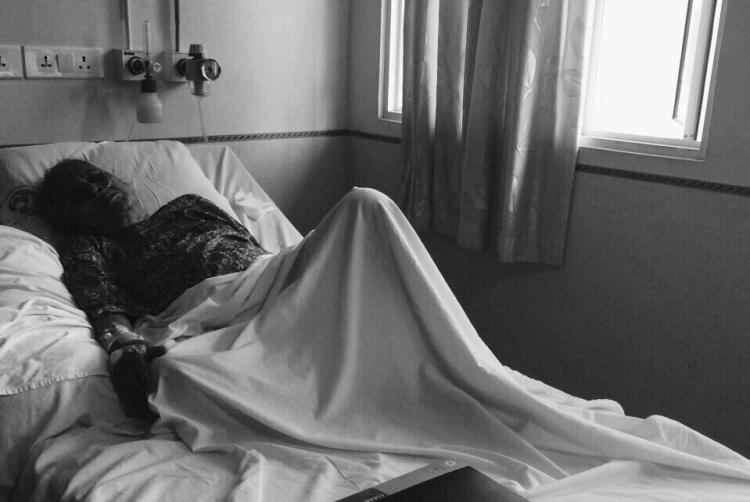
When Maama was admitted at the hospital last year, I can recall how swollen her arms and legs were. I remember how heavy she was because of the swelling and how hard it was to even prop her up to adjust her pillow. At this point she was not given a feeding tube and we were struggling to feed her even 3 spoons of porridge. At this point the Dr had asked us to give her egg whites in an attempt to relieve the swelling. Feeding something as easy to swallow as porridge and soup was already such an arduous task and it was 10 times harder to feed her something she had to chew before swallowing. I remember how the tiffin box that was delivered to the hospital would go home with each container still full because she was unable to eat and I’d tell mom how I’d spent the entire duty convincing her to keep eating. Maama was exhausted and cranky and I had gotten hopeless. But this one day, after she refused to eat the 4th spoon of porridge I held her arm up to her face and showed her how swollen it was. I told her the swelling wasn’t going to go away if she doesn’t eat and that the Dr had said that the only way the swelling would go down was by eating egg whites. I gave up and went on to pack her tiffin box and she said, ‘Bis dheebala’. Those were the happiest words I had heard all day! The tiffin box contained chopped up hard boiled egg-whites of 3 whole eggs and she ate spoon after spoon after spoon until there was none left. I couldn’t believe what I was witnessing but I remained mum and savoured the moment. No one can shake Maama’s beliefs. She was so sick and so out of breath with the Pulse Oxymeter reading as low as 69% at times and yet she finished 3 whole eggs because she put her mind to it.

That’s my Maama! The most hard-headed, most stubborn and most strong-willed person I’ve ever met.


Driftwood

2 months since Maama left us.

I’ve left home for a while and settled in a place bustling with energy, noise and chaos. I assumed that the timing was right for me to leave home. I also assumed that the distraction would be immensely therapeutic for me. I suppose it has been therapeutic for me, albeit not immensely.

The good days are really good and the bad days are so overwhelmingly soul wrenching. Considering what an exceptionally larger than life person Maama was and given that I’ve always  followed her closely for the entirety of my life I guess expecting the grief to be short lived or to become weightless is naive of me.

Two weeks or so prior to Maama’s demise, we had known that bringing her back would be something close to impossible. The doctors asked us to prepare for or even brace for what seemed only inevitable. I recall the physical and mental exhaustion I felt primarily with Maama being in the state that she was in and Kaafa being admitted in the hospital on top of having to prepare for what was to come. At that time, I was new to the concept of death and grief since I had never lost a person so close to my heart. Sure, I’d seen death and the sadness it brings but never like this. The whole thing was unknown to me and I remember feeling scared, unprepared and .. vulnerable. In all that confusion, I remember what Dhombe told me about something he’d read somewhere regarding death and grieving.

Imagine you’re in a boat in the middle of nowhere and suddenly a ginormous wave comes and completely wrecks your boat. Death feels somewhat like that. Unexpected even if you’re really prepared for it. Your boat has been destroyed and all that is left is driftwood. You hold on to pieces of what your boat had been and try to stay afloat because there is no sight of land in the horizon. Somedays, hanging on is hard because on those days the waves are bigger and seas are rougher. On stormy days you can barely hang on and you’re struggling just to stay afloat. But the rest of the days, you are relatively alright without having to put much effort into holding on. That’s what grief does to you. Sometimes it gets really hard because like driftwood you’re holding on to the remnants of the life that she lived. But the rest of the time you’re relatively okay. One day eventually, you’re going to see land and you’ll swim to the shore and be able to come to a place where you’re okay just reminiscing in her memories and celebrating the life she lived.

Dhombe could not have been more right.


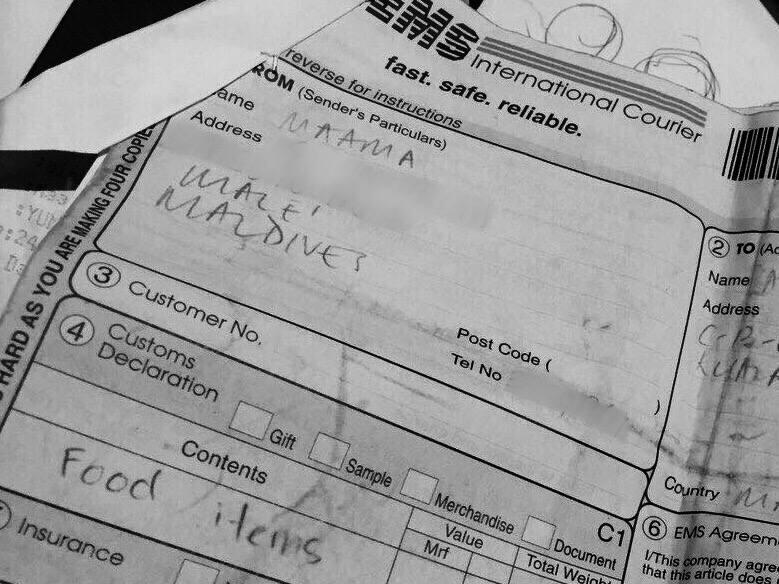
Even thought I may be away from home seeking a distraction and time away from where Maama’s things are as she kept them, I yearn for the lengthy phone calls we made to each other gossiping about politics, complaining about Kaafa, me asking her to make a special prayer because I was to sit for an exam … and saying ‘Maama. Love you ingey. Maama ves bunebala I love you ey’ and she responding by saying ‘Hoon. Aan. I love you. Dhen baavvaa’. Initially, the first few times she said it with a hint of annoyance and amusement because I persuaded her so much. But eventually it came only naturally to her. I also miss receiving small surprise packages of  homemade Thelli Mas, Bajiya and Gulha in the mail; packages she would pester people to take to the post office and post to me. Munching on the crispy pieces of fried tuna was the best remedy for homesickness because they tasted just like home. She made them with her own hands specially for me and double fried them so that I could keep it for months on end. A few days after she left us, I remember discovering postal receipt after receipt of the packages she sent through the mail from 2008 onwards. She had kept them just incase my surprise packages from Maama got lost in the mail.

So much driftwood.


What would Maama say?

As of yesterday 40 days have passed. Maama absolutely loved traditional rituals and so we’ve done 40 days of Quran recital and Fatiha at home. I can almost feel happiness emanating from her knowing what we’ve achieved. Even on days that the seas were rough and getting up from bed the hardest, we’ve managed to pull it off because perhaps this was the last big thing we can do for her. Even on those days, 2 hours of Quran recital has been aboslutely meditative .. and therapeutic even. I can even say it has helped us heal. But more appropriately it has helped us momentarily shift our focus and energy. Maama was the pillar of the family. And Mamma and I would do whatever it takes to make Maama happy.


But what now though? What do we do with the void? What do we do with the silence?


I’ve already found my distraction because I’ve left home for a year. But I cannot even imagine the kind of emptiness at home. Maama’s larger than life personality and presence was what brought life to the house. From dawn till dusk there was never a dull moment at home.


When Maama was well enough she’d get up at early in the morning for prayers and Quran recital. I still have her Quran book with the book mark where she last read. She’d then sleep for a few hours and get up for breaksfast and the house would then be bustling with energy. I always woke up to the sound of her laughing in the kitchen or scolding the maid. I remember how she held the knife while peeling the skin off the Thoraa and how slowly and carefully she sliced onions. She invested so much time and energy into preparing food she’s prepared a hundred times over. Right before noon she would dissapear into her room to take a bath and pray and would emerge again at 2.00 pm to have lunch and watch some TV. She was graceful even when she ate. She held the spoon in her right hand and ate slowly and chewed carefully with her mouth closed. After lunch, she would take a nap until afternoon prayer and then go the balcony for some socialisation and people-watching. I remember how she called out to me when she spotted cats on roofs and we’d both throw pieces of dry fish at the cats hoping we could tame some. Unfortunately, this was always rather unsuccessful and the cats always fleed. Maama would then send the maid to Husnooge for some shorteats for tea. There was never a day she wouldn’t buy some good old Bajiya for me along with some Bajiya and Foni Folhi for her and some Handulu Gulha for Mamma. She was so particular about such things, and they were almost ritual-like. After tea she would then rest until Maghrib and Isha prayer, inbetween which she would recite Quran again. I remember how she sat in her chair and held the book open with both hands. She always read silently and slowly, carefully mouthing word after word. For dinner, she would have some soup in a cup and bread sliced into squares at 8.30 pm. I remember how she pursed her lips while cleaning them and how she washed her fingertipes at the wash basin after her meal. After dinner, Maama would usually call it a night at 9.00 pm and be fast asleep, snoring away by 10.30 pm. I remember, sneaking into her room after she had slept to make sure she was breathing, before I went to bed. Sometimes, she’d be awake and she’d startle me by asking ‘Mihaaru keeh kuran thiulheny?’. I remember how I hugged her on those nights that she was awake and how she would crack a joke and call me Moyagandu before I was able to close her room door behind me.


The absence of the kind of energy and vibrance Maama possessed makes our home just a house. Maama literally laid the foundations of the initial walls of where we live and transformed the house into a haven where there was nothing but unconditional love … and to not have her in it just means that home is no more a home. The void that she left and the silence that now resides there is just deafening and excruciating.


Times like these I wonder what Maama would say.


‘Komme meehakuves dhuniye ah annanee anburaa dhaan. Dhen dhiyaima ekanthah enumeenu? Dhen ekamaa roe, karuna beyleema vaane faidhaa eh noannaane. Namaadhu koh, dhuaa koh, heyo kanthah koh hedheema hunnaanee rangalhah. Keihtheri vaan jeheyne. Undhagu kanthah thakaa ves dhimaavaane.’


Wisdom

I have to leave.

The one thing that tied me to home was Maama. I had always felt a sense of obligation to go back home wherever I was. I felt that Maama needed me. It’s not that Maama was not self-sufficient and independant. Not at all. It lies more in the way she always asked me ‘kon irakun dhen annaanee?’ and ‘las nuve avahah annahchey?’ every time I left the house. Perhaps it gave her a  sense of relief knowing that I was home. Every time there was a murder in town, a political protest or the likes of such a thing she would urge me to stay home and not to go out. She was perpetually worried for my well being. Perhaps, this is the reason why I started feeling a sense of vulnerability immediately after her passing; because my protector was no more.

On day 3 of her admission, I got a call letting me know that my placement was assured. This meant that I had to leave home and Maama for 1 year. I remember going through the course of events in my head and thinking why things happen the way they do. There she was lying on her hospital bed in the ward struggling to breathe … and now this? The dilemma was cruel even. Not just to me, but for Maama too. Recalling the choices I’ve made before, I made up my mind not to leave until Maama left the hospital. That was early November of 2015.

Come December and Maama was in a coma for 30 days on-end. She stopped opening her eyes, stopped trying to pull out the endotracheal tube and stopped grasping my hand even. No one was sure of what was happening and even the doctors were left with ‘leaving it to God’. ‘Perhaps she would bounce back, perhaps not’, they said. Time was definitely not on my side. In my inability to decide whether I should stay or leave, I thought of what Maama would tell me to do. And so I told her.

On the 17th of December 2015, I told Maama that I was faced with a dilemma and that I needed to leave but that I wanted to stay with her. I asked her to help me decide on what to do. I told her how I thought I’d apply for visa that Sunday (20th December 2015) not knowing whether that was the right thing to do. I asked her to decide for me because she always knew what to do. Although she wasn’t able to respond to me, I was somehow confidant that she could hear me. And Maama being Maama, she always helped me get through even the most trying of times.

And she decided for me. Just like that.

The morning of day I was supposed to apply for my visa, she left. After weeks and days of not budging to even the best treatment and then being on palliation she decided to leave. Just like that. After I got a chance to regain my composure and gather my thoughts to some extent, I realised how, even in death, Maama was the wisest person I’ve ever known. She knew how intently I loved her, and perhaps she also knew that if I had to leave while she was still in the hospital, I wouldn’t be able to forgive myself if something were to happen to her.

And so she untied me from that guilt. I was no longer bound by an obligation to be home.

Ward Maama.jpg

The Day Before

19th December 2015. I had just come for my shift at the hospital. I can very clearly recall the sense of relief I was feeling, knowing that Maama was now stable according to the briefing with the doctor I had the day before. Unlike other days, I wasn’t too restless or anxious. The doctor had said that we could consider Maama to be stable now and that she wasn’t critical as such anymore even thought she wasn’t responding to any sort of stimuli. The plan had been to continue on Palliation until … Maama decides to leave. I was alright with it. As long as Maama was not in pain.

I remember walking into Maama’s cubicle at around 11.30 am and commencing my usual routine. For the past 28 days of her admission I had always had a specific drill that I undertook before I say a word or even touch Maama, and this time was no different. I looked at the Ventilator for any changes to it’s settings,  then I looked at her urine bag for her urine output and finally, I checked the monitor for her vitals … and I froze. ‘This is not good. This is not good!’, I thought aloud. Maama’s pulse, blood pressure and Oxygen saturation had all dropped significantly. ‘Maama?’, I called out to her and patted her shoulder by force of habit, hoping that this would help. And nothing. I sped out of her cubicle and called a nurse and enquired. ‘No. She’s been like that the whole day today. We’re not sure what’s happening either’, he said. ‘Are you going to give her something to pick up the blood pressure and change her ventilator settings?’, I asked. The nurse replied that he’d ask the doctor and left.

I felt weak in my legs and could barely hold my self up. I knew I needed to be with her for as long as I could. I remember lifting up her blanket to get access to her hand and saw that her left hand was not just swollen but had now turned black. The lump in my throat came back, but I knew what I had to do and so started speaking to Maama and reciting the Shahada and Surat al Fatihah. I remember anxiously  and repeatedly glancing at her monitor to see if any of her vitals picked up but all I saw was ‘VT Run’ and the amber light flashing indicating that she was not okay.

Forty minutes or so later I remember the nurse coming into the cubicle and gently asking me to leave since the visiting hours were over. I asked her for one more minute with Maama because I needed to tell her something important. I walked over to Maama and whispered in her ear with my hand on her forehead.

‘Maama annahchey kokko kairiah? Love you ingey?’

‘Maama. You’ll come back to me, no? I love you’

What an absolutely childish thing to do. Almost forty days in the ICU and I was still not ready to let her go.

As per ICU rules, visitors are only allowed inside except during 2 hours allocated as visiting hours. I sat outside the ICU waiting impatiently. Part of me knew that I’d done everything I could do and that it was now up to a higher power, but the other part of me wanted to barge into the ICU .. and just stay with her and hold her hand.

‘ICU Bed number 1, Thithi Kamana’s relative please come to the ICU’

I jolted at the sound of the PA system and ran into the ICU. The nurse looked at me and asked, ‘Are you Thithi Kamana’s relative? I’m sorry but is there an adult around?’. This was the second time I was asked this question. ‘I am an adult. I am her granddaughter and I’m here now. I’m also a Doctor so I can comprehend whatever you tell me’. I was a little upset as this back-and-forth thing between the nurse and I was just hindrance in getting the information I needed. After my response I was asked to come into the ICU, where Maama’s consultant was waiting for me. ‘She’s not doing well. Her BP, pulse and Oxygen Saturation are all low. We’ve changed her Ventilator setting and we’ve started her on an Inotrope drip. We’ll change it to something else if it doesn’t work. We’re trying whatever we can’. He looked troubled and confused, similar to his expression the day he told us she is to be put on Palliative care only. ‘You’ll let me know if she .. if anything changes right?’, I asked him. He nodded.

I remember walking out of the ICU and to the balcony and taking a moment to breathe. ‘Can I do this by myself? Do I want someone here with me?’, I thought to myself questioning my ability to handle what was now inevitable. Subsequently I called Mamma and asked her to come. I couldn’t and didn’t want to be alone when something happens. Now, it was not a matter of if something were to happen anymore. It was a matter of when. I knew Maama didn’t even have a day left to live.

I was right. 21 hours later, she left us.


Contentment

Maama and I frequently called each other funny names, and anyone who had even momentarily been in our presence knew that Maama and I had this quirk about us. Sometimes I’d call her ‘Maama Gandu’ and she’ll respond with ‘Hidhaya Kolhu’ and proceed to tell me that I was the silliest girl she’s ever met. In her words, I was a Moyagandu. To be exact I was ‘Migey Moyagandu’.  Sometimes, just to make her laugh while going out, I’d stand at the doorway of the apartment and yell, ‘Dhanee Maama. Dhanee ingey? Dhanee Maama Gandaa!’ over and over again until she laughed loudly and exclaimed ‘Thi dhaathaakah dheveyne baa?’. We would often made funny faces and silly hand gestures at each other too. These exchanges were often made while she stood on the 2nd floor balcony and I downstairs. I think our neighbours, at one point, eventually got used to the idea that this was merely our thing, and we were absolutely shameless about it.

For the past few years, our routine had been to refer to each other with names of vegetables.

‘Maama Kattala!’, I’d say.

‘Hidhaya Tholhi!’, she’d respond, right on cue.

Oftentimes, whenever she’d see me rummaging around the house she’d call out to me as such and we’d fire away at each other, ending up with both of us in a laughing fit. To reflect on it, I’d say Maama absolutely loved this and it cheered her up every time. I remember vividly how her eyes lit up when she grinned.


During Maama’s hospital stay, I usually stayed with her from the morning until the afternoon, and I remember very clearly how her condition progressively deteriorated because I was able compare how well she was able to speak on a day to day basis. Initially, I was able to make conversation with her but the last two days before she was shifted to the ICU, she was incomprehensible and only able to say ‘Aan’ in a struggle to exhale. Sometimes her Oxygen Saturation would drop because she falls asleep and in a sorry attempt to keep her awake I’d try to make conversation, prop her bed up and switch on the TV and set to a Bollywood Drama channel. Of course, during those few days she was too unwell and my attempts were in vain.

What I missed most during those last few days was how we called each other silly names and how she laughed with her eyes. My heart ached. I knew Maama was slowly being taken away from me.

The day before she was shifted to the ICU, I was just finishing my shift with her and got up to leave. That day Maama was too weak to even utter a word to me and I remember having spent 6 hours next to her unable to make her say a word. While leaving I whispered to my husband how Maama wasn’t able to speak to me and he prompted me to make one more attempt.

I caressed her forehead, kissed her face and prompted, ‘Thee Kokkoge Maama Kattala tha?’.

‘Aan! Thee Hidhaya Tholhi’, she lifted her eyebrows, opened her eyes and responded.

Unknowingly, I clutched my chest. I stood frozen for a second or two and felt a sense of warmth in my heart. I glanced at my husband and saw him smile.

Little did I know, at that time, that that was the last thing she’d ever say to me.

A day later, Maama was in the High Priority Ward being shifted to the ICU. I remember the additional efforts I made that day too to keep her awake and to make her say something … anything. A minute or two before the doors to the ICU closed behind Maama I prompted her one more time.

‘Maama Kattala?’, I asked.

Aan!’, she exhaled.

I am unsure of whether she said this in a struggle to breathe or whether I was even comprehensible to her. But recalling how she responded to me the day before,  I was sure of one thing. That even in the state that she was in, she was able to recall our silly and happy memories and put an insumountable amount of effort to respond to me to make me smile.

How could I not be content knowing that?

Processed with VSCOcam with b1 preset

How to Tenderise Beef

‘When in doubt, ask Maama’ has been my mantra in life. Whether it was an indecisiveness about how much sugar to put into the Bajiya mix, the need to recall a historical moment or what home remedy to go for when you feel nauseous, I always ran to Maama.

I remember 2 months or so ago when I came across a conundrum. I had bought a pound or two of beef and I wanted to prepare Beef Rendang with a packet of readymade sauce that I bought. Easy enough, I had thought. But I had no idea how to tenderise beef. I often saw Maama busy as a bee, cutting the beef and mixing in some sort of concoction followed by the house being aromatised with the flavourful smell of cooked beef. But I had absolutely no clue of how she did. I remember standing near the doorway  of her room and telling her that I had come across a strife and that I needed her help. Her signature chuckle was followed by a set of instructions on how to cut, marinate and cook beef. ‘How much beef did you buy?’, she chuckled. I told her that it must have been half a kilo or so. She chuckled again and proceeded to instruct me.

Gerimahun rangalhah sarubee filuvan vaane. Varah undhagu vaane sarubee filuvan ekamaku varah rangalhah filuvanvaane. Dhen beynun varakah valhin gerimas thah kudhi kuraanee. Dhen nimuneema reethikoh dhonnaathi hurihaa mas buri thakeh. Rangalhah ley filuvan vaane ingey? Dhen lunboa falhiakaa, chis koffa huri lonumedhaa inguraa, kuda lonu kolhakaa 2 kuda samsaluge baking soda alhaigen ekkolaanee. Dhen ekkaireega bahattaafa migeyga inna bodu math jehi theli hoadhaa. Dhen madu gineega eyah laigen kakkaalaa. Fen alhaakah nujeheyne. Eyge thereyga hunna fenthah nukumegen amillayah kekeyne. Samsalakun ekkohlan vaane ingey. Ehennoonee fuluga hifaane. Fen hindhuneema eheree maduvefa. Maa undhaguleh noonennu?’

‘Make sure you take the beef and remove all the fat. It’s a laborious task but it’s very important that you remove the fat very carefully. You can do this while you cut the beef pieces to a size that you prefer.  After you’re done cutting the beef, wash it thoroughly and clean all the blood. Then, you take some lime, some crushed garlic and ginger, some salt to taste and two teaspoons of baking soda. Mix it well and leave aside for a little while. Take the large pot with the lid and put everything into it and set to low heat and cook. You wouldn’t need to add water because all the moisture inside the beef will come out and cook itself. But make sure you mix it it with a spoon once in a while, okay? Once all the water dries up, your beef has tenderised. Not too difficult no?’

Half an hour later I had a pot of tenderised, aromatic and flavourful beef. And I remember telling her that she was spot-on and that the smell of the cooked beef induced much nostalgia of her making us her signature beef curry. She chuckled and went on to say that tenderising beef was never such a difficult task and that I just needed a little patience. As always, Maama was my go-to person for every such thing. And perhaps in saying that she taught me her last lesson about life. That nothing was too difficult, and that you just needed a little patience to sort things out.


I was text-messaging a friend today and pondered upon a similar and familiar uncertainty that I needed her to clarify urgently. I needed Maama to confirm the background of a mutual friend and I knew she’d chuckle and say, ‘Aan. Eiee Eydhafushee kujjennu‘ or something. ‘When in doubt, ask Maama’. So I instinctively got up from my seat and headed out from my room. I even visualised Maama on her bed, wiggling her toes and blowing up a balloon through a straw to exercise her lungs. Maama always knew everything and she had magical powers of recall.

And it hit me. Mercilessly and where it hurt the most. I froze in my footsteps.

Maama passed away. She’s gone. She’d dead.

My go-to person for answers about life, the universe and everything is no more.