Driftwood

2 months since Maama left us.

I’ve left home for a while and settled in a place bustling with energy, noise and chaos. I assumed that the timing was right for me to leave home. I also assumed that the distraction would be immensely therapeutic for me. I suppose it has been therapeutic for me, albeit not immensely.

The good days are really good and the bad days are so overwhelmingly soul wrenching. Considering what an exceptionally larger than life person Maama was and given that I’ve always  followed her closely for the entirety of my life I guess expecting the grief to be short lived or to become weightless is naive of me.

Two weeks or so prior to Maama’s demise, we had known that bringing her back would be something close to impossible. The doctors asked us to prepare for or even brace for what seemed only inevitable. I recall the physical and mental exhaustion I felt primarily with Maama being in the state that she was in and Kaafa being admitted in the hospital on top of having to prepare for what was to come. At that time, I was new to the concept of death and grief since I had never lost a person so close to my heart. Sure, I’d seen death and the sadness it brings but never like this. The whole thing was unknown to me and I remember feeling scared, unprepared and .. vulnerable. In all that confusion, I remember what Dhombe told me about something he’d read somewhere regarding death and grieving.

Imagine you’re in a boat in the middle of nowhere and suddenly a ginormous wave comes and completely wrecks your boat. Death feels somewhat like that. Unexpected even if you’re really prepared for it. Your boat has been destroyed and all that is left is driftwood. You hold on to pieces of what your boat had been and try to stay afloat because there is no sight of land in the horizon. Somedays, hanging on is hard because on those days the waves are bigger and seas are rougher. On stormy days you can barely hang on and you’re struggling just to stay afloat. But the rest of the days, you are relatively alright without having to put much effort into holding on. That’s what grief does to you. Sometimes it gets really hard because like driftwood you’re holding on to the remnants of the life that she lived. But the rest of the time you’re relatively okay. One day eventually, you’re going to see land and you’ll swim to the shore and be able to come to a place where you’re okay just reminiscing in her memories and celebrating the life she lived.

Dhombe could not have been more right.


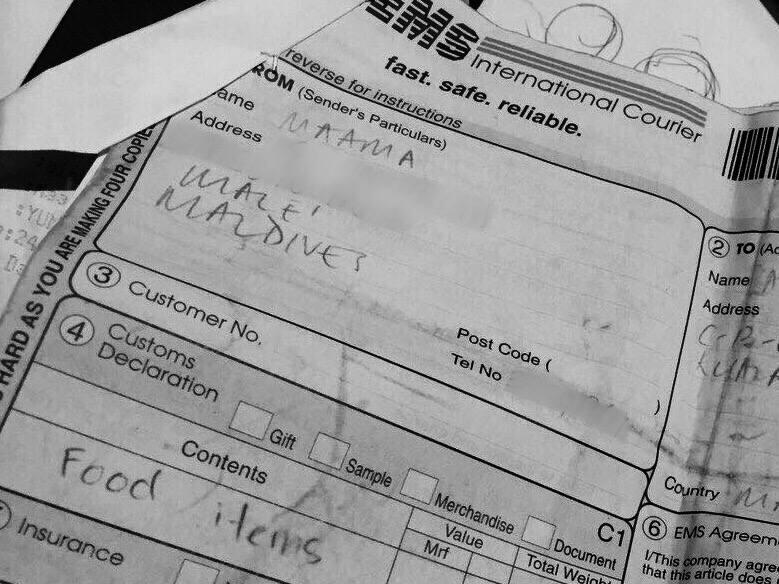
Even thought I may be away from home seeking a distraction and time away from where Maama’s things are as she kept them, I yearn for the lengthy phone calls we made to each other gossiping about politics, complaining about Kaafa, me asking her to make a special prayer because I was to sit for an exam … and saying ‘Maama. Love you ingey. Maama ves bunebala I love you ey’ and she responding by saying ‘Hoon. Aan. I love you. Dhen baavvaa’. Initially, the first few times she said it with a hint of annoyance and amusement because I persuaded her so much. But eventually it came only naturally to her. I also miss receiving small surprise packages of  homemade Thelli Mas, Bajiya and Gulha in the mail; packages she would pester people to take to the post office and post to me. Munching on the crispy pieces of fried tuna was the best remedy for homesickness because they tasted just like home. She made them with her own hands specially for me and double fried them so that I could keep it for months on end. A few days after she left us, I remember discovering postal receipt after receipt of the packages she sent through the mail from 2008 onwards. She had kept them just incase my surprise packages from Maama got lost in the mail.

So much driftwood.
  

What would Maama say?

As of yesterday 40 days have passed. Maama absolutely loved traditional rituals and so we’ve done 40 days of Quran recital and Fatiha at home. I can almost feel happiness emanating from her knowing what we’ve achieved. Even on days that the seas were rough and getting up from bed the hardest, we’ve managed to pull it off because perhaps this was the last big thing we can do for her. Even on those days, 2 hours of Quran recital has been aboslutely meditative .. and therapeutic even. I can even say it has helped us heal. But more appropriately it has helped us momentarily shift our focus and energy. Maama was the pillar of the family. And Mamma and I would do whatever it takes to make Maama happy.


But what now though? What do we do with the void? What do we do with the silence?


I’ve already found my distraction because I’ve left home for a year. But I cannot even imagine the kind of emptiness at home. Maama’s larger than life personality and presence was what brought life to the house. From dawn till dusk there was never a dull moment at home.


When Maama was well enough she’d get up at early in the morning for prayers and Quran recital. I still have her Quran book with the book mark where she last read. She’d then sleep for a few hours and get up for breaksfast and the house would then be bustling with energy. I always woke up to the sound of her laughing in the kitchen or scolding the maid. I remember how she held the knife while peeling the skin off the Thoraa and how slowly and carefully she sliced onions. She invested so much time and energy into preparing food she’s prepared a hundred times over. Right before noon she would dissapear into her room to take a bath and pray and would emerge again at 2.00 pm to have lunch and watch some TV. She was graceful even when she ate. She held the spoon in her right hand and ate slowly and chewed carefully with her mouth closed. After lunch, she would take a nap until afternoon prayer and then go the balcony for some socialisation and people-watching. I remember how she called out to me when she spotted cats on roofs and we’d both throw pieces of dry fish at the cats hoping we could tame some. Unfortunately, this was always rather unsuccessful and the cats always fleed. Maama would then send the maid to Husnooge for some shorteats for tea. There was never a day she wouldn’t buy some good old Bajiya for me along with some Bajiya and Foni Folhi for her and some Handulu Gulha for Mamma. She was so particular about such things, and they were almost ritual-like. After tea she would then rest until Maghrib and Isha prayer, inbetween which she would recite Quran again. I remember how she sat in her chair and held the book open with both hands. She always read silently and slowly, carefully mouthing word after word. For dinner, she would have some soup in a cup and bread sliced into squares at 8.30 pm. I remember how she pursed her lips while cleaning them and how she washed her fingertipes at the wash basin after her meal. After dinner, Maama would usually call it a night at 9.00 pm and be fast asleep, snoring away by 10.30 pm. I remember, sneaking into her room after she had slept to make sure she was breathing, before I went to bed. Sometimes, she’d be awake and she’d startle me by asking ‘Mihaaru keeh kuran thiulheny?’. I remember how I hugged her on those nights that she was awake and how she would crack a joke and call me Moyagandu before I was able to close her room door behind me.


The absence of the kind of energy and vibrance Maama possessed makes our home just a house. Maama literally laid the foundations of the initial walls of where we live and transformed the house into a haven where there was nothing but unconditional love … and to not have her in it just means that home is no more a home. The void that she left and the silence that now resides there is just deafening and excruciating.


Times like these I wonder what Maama would say.


‘Komme meehakuves dhuniye ah annanee anburaa dhaan. Dhen dhiyaima ekanthah enumeenu? Dhen ekamaa roe, karuna beyleema vaane faidhaa eh noannaane. Namaadhu koh, dhuaa koh, heyo kanthah koh hedheema hunnaanee rangalhah. Keihtheri vaan jeheyne. Undhagu kanthah thakaa ves dhimaavaane.’